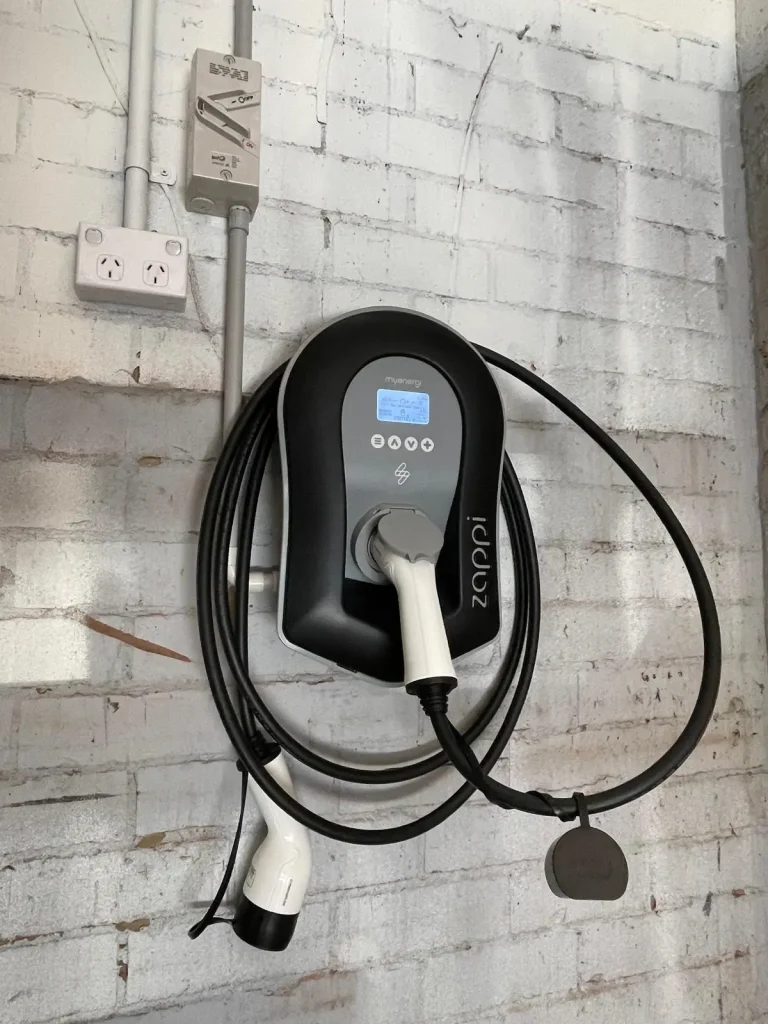
More Melbourne households are plugging in every month. The cars are getting cheaper, the range is getting longer, and Victoria now has more than 180,000 registered electric vehicles on the road. But here is what most new EV owners work out within their first fortnight: the public network is fine for road trips and useless for daily life. Home charging quietly handles the other 90 percent of your driving. Cheap power overnight, full battery by breakfast, no detour to a public bay.
That is where a proper home charger earns its keep. It is also where a lot of buyers get stuck, because the choices are not obvious and the wrong setup can cost you for the next ten years. This guide walks you through everything that matters before you book an EV charger installation in Melbourne: the charger types, the charging speeds, the solar angle, what it costs in 2026, the rebate reality, and how to pick an installer who quotes a fixed price and stands behind the work.
Let’s break it down.
Why a Home Charger Beats the Wall Socket
You can technically charge an EV from a standard 10-amp power point using the “granny charger” that comes in the boot. It works. It is also painfully slow, hard on the circuit, and not built for the load night after night.
The maths tells the story. A granny charger delivers around 2 to 2.4 kW, which means a typical 60 kWh EV crawls back to full over roughly 25 hours from empty. A dedicated 7 kW wall charger cuts that to about 8 to 10 hours, comfortably overnight. A 22 kW three-phase unit gets you there in around 3 hours. So a car that limps back to full over two days on a wall socket is sitting at 100 percent by the time you have had your coffee.
There is a safety angle too, and it is not a nice-to-have. A hardwired charger runs on its own dedicated circuit with the right protection, sized and installed to AS/NZS 3000 with RCD safety devices on the circuit. Repeatedly drawing high current through a general power point built for lamps and phone chargers is exactly the kind of thing that overheats over time. A proper install removes that risk entirely.
EV Charger Levels Explained
Before you compare units, it helps to know the three tiers of charging. You will see them referenced everywhere.
Level 1 (the granny charger). Plugs into a normal 10-amp socket. Around 2 to 2.4 kW. Fine as a backup or for a plug-in hybrid, too slow for daily life with a full battery EV.
Level 2 (the home wall charger). The sweet spot for home. A wall-mounted, hardwired unit running at 7 kW on single-phase or up to 22 kW on three-phase. This is what almost every Melbourne household should be installing. Fast enough to fully charge overnight, smart enough to schedule and to work with solar.
Level 3 (DC fast charging). The 50 kW to 350 kW rapid chargers you see at public stations run by Chargefox, Evie and the Tesla Supercharger network. These are commercial-grade, not a home product. You use them on a road trip, not in your garage.
For 95 percent of buyers, “EV charger installation Melbourne” means a Level 2 wall charger. The rest of this guide focuses there.
How Fast Will It Actually Charge?
Charging speed comes down to kilowatts. Here is roughly what each power level adds per hour, and how long it takes to refill a typical 60 kWh battery from near empty.
| Charger | Power | Range added per hour | 0 to full (approx) |
|---|---|---|---|
| Granny charger (Level 1) | 2 to 2.4 kW | 7 to 10 km | 25+ hours |
| Single-phase wall charger | 7 kW | 40 to 50 km | 8 to 10 hours |
| Three-phase wall charger | 11 kW | 60 to 70 km | 5 to 6 hours |
| Three-phase wall charger | 22 kW | Up to 150 km | Around 3 hours |
The takeaway is simple. A 7 kW unit already refills a normal day’s driving many times over while you sleep. You rarely need more for a single-car household. The case for 22 kW gets stronger with two EVs, long daily commutes, or a car that can actually accept that speed. More on that next.
Single-Phase or Three-Phase: Check Your Switchboard First
This is the part most buyers skip, and it decides everything.
Most older Melbourne homes are single-phase, which caps you at around 7 kW. Plenty of newer builds and renovated homes have three-phase power, which unlocks 11 kW and 22 kW units. Before you fall in love with a fast charger, open your switchboard or have an installer check it. If you have single-phase and your heart is set on 22 kW, getting three-phase brought in from the street is a separate job that can add anywhere from $2,000 to $5,000 through your distributor. Worth knowing before you commit, not after.
Match the Charger to Your Car, Not the Hype
A charger cannot push more power than your vehicle is built to accept. This trips up a lot of buyers.
Many popular EVs cap their onboard AC charging at 7 kW or 11 kW. If your car tops out at 7 kW, a 22 kW charger is money you will literally never use, because the car throttles it down anyway. Some models do accept 11 kW or higher, which is where three-phase pays off. The rule: find your car’s onboard AC charging limit first, then buy to match it. Pay for the speed your car can use, not the number on the box.
Smart Features Worth Paying For
App control, scheduling and load balancing sound like marketing until you live with them. A few are genuinely worth the spend in Melbourne.
Scheduling is the big one. It lets the charger fire automatically during off-peak windows on a time-of-use tariff instead of paying peak rates. Set and forget. We will cover those windows below.
Load balancing (dynamic load management) watches your home’s total draw and dials the charger back when the oven, aircon and kettle are all running, so you never trip the main. Essential on homes with tight supply.
Solar awareness lets the charger sip your rooftop surplus instead of the grid. This is the feature that changes your running costs the most, and it gets its own section.
OCPP and app control give you scheduling, usage history and remote start from your phone, plus future-proofing if you ever move to a smarter energy plan.
The Solar Angle That Changes Everything
If you have rooftop solar, or you are weighing it up, this is the most important section on the page.
A solar-aware charger watches your home’s energy flow in real time and charges your car using the surplus your panels are generating, rather than pulling from the grid. Here is why that matters so much right now. Solar feed-in tariffs in Victoria have collapsed to just a few cents per kWh, so exporting your midday solar barely pays. Pour that same surplus straight into your car instead and you are driving on close to free kilometres. That is a far better use of your panels than selling power back to the grid for loose change.
Units built for this are worth knowing by name:
- myenergi Zappi is the classic solar-aware charger and the most recommended unit for Melbourne homes. It can run your car on close to 100 percent renewable energy and is widely supported locally.
- Sungrow, Enphase and Sigenergy go a step further by integrating tightly with their own inverter and battery ecosystems, so the charger, the panels and the home battery all talk to each other and balance the load automatically.
- Tesla Wall Connector is clean, fast and works with any EV via the included adapter, though it charges at a fixed rate and does not natively prioritise solar surplus the way a Zappi does.
This is exactly why pairing the charger with your existing system matters. A charger configured by a team that understands solar will be set to prioritise your panels. One bolted on by a generalist sparky often just charges from the grid like any other appliance, and you lose the entire advantage you paid for.
What Does EV Charger Installation Cost in Melbourne in 2026?
Pricing depends on the unit you choose, whether your home is single-phase or three-phase, and how far the charger sits from your switchboard. Here is what the current Melbourne market looks like.
The hardware. Entry-level chargers start around $400 to $800. A quality smart, solar-aware unit like a Zappi typically sits in the $900 to $1,900 range. Premium options reach around $3,000.
Installed price (hardware plus labour). A single-phase 7 kW wall charger generally lands between $1,200 and $2,200 fully installed. A three-phase 22 kW install runs higher, roughly $2,500 to $4,500. Industry price tracking puts the Victorian average for a complete home charger install at a little over $2,300 including GST as of early 2026.
The variables that move the price:
- Distance from the switchboard to the charger, and the cable run required.
- Whether your switchboard needs upgrading, which can add roughly $800 to $2,500.
- Outdoor mounting, which adds weatherproofing and conduit (often a few hundred dollars).
- Bringing in three-phase power if you do not have it ($2,000 to $5,000 via your distributor).
A short cable run to a nearby board is straightforward and sits at the lower end. A long run across the house or a switchboard upgrade pushes you up. This is why a proper on-site assessment and a fixed quote matter so much. The honest answer to “what will it cost” is “let an installer see your switchboard,” and any quote given before that is a guess.
Rebates and Incentives in Victoria: The 2026 Reality
Let’s be straight, because plenty of outdated articles online will tell you otherwise. As of 2026, there is no active Victorian rebate specifically for home EV charger installation. The old Zero Emissions Vehicle subsidy ended back in 2023, and the state EV purchase rebate has wound up too.
That said, there are still ways to bring your effective costs down:
- Solar Homes Program. Solar Victoria’s solar panel rebate, worth around $1,400 for eligible households (income under $210,000), is still active. It does not cover the charger itself, but it makes the solar that powers your car far cheaper, which is where the real long-term saving lives.
- Federal Cheaper Home Batteries rebate. Around $3,300 off a 10 kWh battery. Again, not a charger rebate, but a battery lets you store cheap or solar power and run the car on it after dark. Note the rebate value steps down over 2026, so timing matters.
The smarter play in Victoria is not chasing a charger rebate that no longer exists. It is pairing your charger with subsidised solar so your kilometres cost next to nothing for the life of the car.
Charging Cheaper: Off-Peak and Time-of-Use Windows
If you do not have solar, scheduling is your best friend. Most Victorian homes can move to a time-of-use tariff, where power is cheapest overnight and during the solar-soak hours of the day, and most expensive in the evening peak.
Under the current Victorian Default Offer structure, the typical windows look like this:
- Off-peak: roughly 9 pm to 11 am (cheapest grid power)
- Solar soak: roughly 11 am to 4 pm (very cheap, lots of solar on the grid)
- Peak: roughly 4 pm to 9 pm (most expensive, avoid charging here)
Peak rates across Melbourne sit anywhere from the mid-20s to mid-40s in cents per kWh depending on your network and retailer, while off-peak is a fraction of that. Some retailers now offer dedicated EV plans with ultra-cheap overnight charging windows. Set your charger to fire during off-peak, and your “fuel” bill drops dramatically compared with the petrol it replaced. Always check your own retailer’s energy fact sheet for the exact rates and times that apply to your home.
What to Look For in an Installer
The hardware gets all the attention, but the install is where jobs go right or wrong. A few non-negotiables.
CEC accreditation. For anything touching solar, you want a Clean Energy Council accredited installer, not just a licensed electrician. It is the standard that keeps your system compliant and your rebates valid.
Brand certification. Some manufacturers, Tesla among them, certify installers specifically for their hardware. A Tesla-certified installer doing your Tesla Wall Connector is the difference between a clean job and a warranty headache.
A fixed-price quote in writing. The price you are quoted should be the price you pay. Walk away from anyone who is vague about cost or leaves the wiring run open-ended, because that is where surprise invoices hide.
A warranty that means something. The hardware carries the manufacturer’s warranty. The workmanship is on the installer. A lifetime workmanship warranty tells you the installer genuinely stands behind the part they control.
If you want a benchmark for how a properly accredited Melbourne provider packages all of this, MainSwitch Energy is a useful reference point. The team is both CEC Accredited and Tesla certified, installs every major brand from Tesla and Zappi to Sungrow, Enphase and Sigenergy, and backs the work with a lifetime workmanship warranty plus a fixed-price quote. They also run an on-time guarantee, paying you $50 cash if they turn up late, which tells you something about how they treat your day.
The Installation Process, Step by Step
The process itself is simple when it is done right:
- Free assessment and fixed quote. An accredited installer checks your switchboard, your power type and the best spot for the unit, then gives you a no-obligation, fixed-cost price.
- Confirm the setup. Single-phase or three-phase, cable pathway, and charger position are locked in.
- Install day. The charger is mounted, hardwired onto its own protected circuit with RCD safety, and routed to AS/NZS 3000 and 3008 standards.
- Test and hand over. The unit is tested, the grid connection is confirmed with your local network, the app is set up, and you are walked through scheduling and solar settings.
For most Melbourne homes it is a same-day job.
EV Charger Installation Melbourne: FAQ
How much does an EV charger cost to install in Melbourne? A single-phase 7 kW wall charger typically costs $1,200 to $2,200 fully installed in 2026. A three-phase 22 kW unit runs roughly $2,500 to $4,500. A switchboard upgrade, if needed, adds around $800 to $2,500.
Do I need a 7 kW or 22 kW charger? For most single-car Melbourne households, 7 kW is plenty and fully charges overnight. Go for 22 kW only if you have three-phase power, a car that accepts it, two EVs, or very high daily mileage.
Can I just use the charger that came with my car? You can, but it only delivers around 2 to 2.4 kW and can take 25-plus hours to fully charge. It is a backup, not a daily charging setup.
Is there a government rebate for home EV chargers in Victoria? Not currently. There is no active Victorian rebate for home EV charger installation in 2026. You can still claim the Solar Homes solar panel rebate and the federal battery rebate, which make charging from your own solar much cheaper.
Should I get a solar-compatible charger? If you have or plan to get rooftop solar, yes. A solar-aware charger like a Zappi runs your car on surplus solar instead of the grid, turning excess generation into nearly free kilometres.
How long does installation take? For most homes, a standard wall charger install is completed in a single day.
Do I need a CEC-accredited installer? For anything involving solar, yes. CEC accreditation keeps your system compliant and protects your rebate eligibility. For a Tesla Wall Connector, also look for Tesla certification.
The Bottom Line
A home EV charger is a ten-year purchase, not a weekend impulse buy. Get the power type right, match the unit to your car, lean hard into solar if you have it, schedule your charging for off-peak, and choose an accredited installer who quotes a fixed price and stands behind the work. Do that, and you will wake up to a full battery and cheap kilometres for the life of the car.
Ready to Charge Smarter at Home?
Lock in your fixed-price quote today. Book a free, no-obligation assessment with a CEC Accredited and Tesla-certified Melbourne team. Call 1300 624 679 now. No surprises, no hidden wiring costs.
Get the install done right the first time. Tesla, Zappi, Sungrow, Enphase and Sigenergy, all installed by accredited pros and backed by a lifetime workmanship warranty. Request your free quote online now.